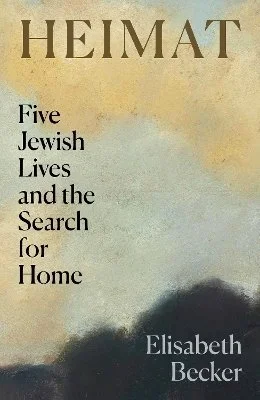
Heimat: Five Jewish Lives and the Search for Home (Verso 2027)
Heimat is not a word that can be translated easily: it means home, or the spirit of place. When Elisabeth Becker moves to Berlin from New York she goes in search of that spirit among the streets and monuments, navigating between a catastrophic past and a precarious present.
As guides to the ghosts of Jewish Berlin, Becker walks with writer and thinker Walter Benjamin, political theorist and philosopher Hannah Arendt, scientist Albert Einstein, artist Max Liebermann and poet Mascha Kaléko. Each experienced the reconfiguration of home in 1930s Berlin in the face of rising fascism, and all except one sought a new sanctuary abroad. Benjamin first fled to Paris and then took his own life when he was unable to escape through Spain. Arendt made it to the US but wrestled with her understanding and reconciling her past for the rest of her life. Einstein sought comfort in the peace movement and the universal community of science after fleeing to Princeton, New Jersey. Kaléko, who lived her own exile largely in New York City and Jerusalem, continued to long for Berlin across her own exile, with this sentiment marking her emigration poems. And Liebermann attempted to find solace in art, while remaining in Berlin in times of great tumult, where he died in 1935.
These lives are told in conversation with Berlin today, which is still dealing with the legacy of its past, as well as a new Jewish present. Becker explores the city in search of its ghosts and its future, asking fundamental questions about the nature of the city, the idea of home and Jewish belonging at times of great uncertainty. Ultimately, she suggests that Heimat exists at the interstices between place and text, in the spaces that we live as well as the stories that we tell: and that even when lost, hope in Heimat remains.
“Becker's project, building bridges from important prewar German Jews to contemporary German Jews, remaking their peoplehood, is of interest to scholars, world travelers, cosmopolitan flâneurs, history buffs, Jews, those curious about Jews, and indeed anyone who still thinks that European history is written for good. Heimat promises to be a great read, but more than that it promises to be influential, interdisciplinary, and unignorable. Indeed, it may well prove indispensable.”
―Mark Oppenheimer, author of Squirrel Hill: The Tree of Life Synagogue Shooting and the Soul of a Neighborhood